Funding programme: Erasmus+
Call: [ERASMUS-EDU-2021-PI-ALL-INNO]
Project coordinator: European Health Management Association (EHMA)
Other partners: ECHAlliance, EuroHealthNet, Istituto Tecnico Superiore per le Nuove Tecnologia della Vita, COCIR, EIT Health, University of Thessaly, European Health Telematics Association (EHTEL), European Federation of Nurses Associations (EFN), EUROMASC, Viennese Institute for Labour Market and Education Research (WIAB), Netherlands Institute for Health Services Research (NIVEL), Datey Eyrich GmbH, Babes-Bolyai University, Universita degli Studi di Bergamo, World Health Organization (WHO), European Specialist Nurses Organisation (ESNO), CESI International, European Forum for Primary Care (EFPC), European Community Pharmacists (PGEU), Medical University of Varna, Biomedical Alliance, Innlandet Fylkeskommune,
Role of EUREGHA: Leader of Work Package 8 on “Sustainability and Exploitation”
Total budget: €3.755.275,00 EUREGHA budget: €199.544,00
The BeWell project (Blueprint Alliance for a Future Health Workforce Strategy on Digital and Green Skills) aims to form an alliance, to build a movement of all healthcare stakeholders supporting and committing to the development, implementation, and upscaling of the strategy on upskilling and reskilling of the European health workforce.
The ultimate project aim is to develop a green and digital skills strategy for the health ecosystem that can be implemented at a local, regional, national, and ultimately at the European level through the Pact for Skills. By addressing the existing skill mismatches and strengthening these competencies, the project will enable the health workforce to be better prepared to face future challenges and adapt to ever-evolving societal contexts.
To do this, the project will build comprehensive curricula and training programmes that will target all professionals of the health workforce, including health students, health professionals (nurses, doctors, operators, managers) and professionals of emerging occupations. The training programmes co-created by universities, VET providers and companies will reach the target populations through initial education and continuing professional development.
The project methodology is developed based on principles to respect and unite the diversity of Europe’s health ecosystem: Patient centeredness; collaboration and co-creation; inclusiveness and diversity; intersectorality; comparative research; dynamic coverage; digital skills for skill-mix innovations in care integration; green skills, and; environmental sustainability and responsible practice. The consortium consists of 24 beneficiaries and 5 associated partners from 11 countries. The geographical diversity in partners ensures the representation of different cultural, social, political, educational structures, values and traditions. The partnership brings together a substantial and diverse pool of leaders representing stakeholders in the health sector at regional, national, and European levels.
The Large Scale Partnership
Through the BeWell Large-Scale Partnership for the Health Ecosystem, EUREGHA works with public authorities, education and training providers, social partners, industry and research organisations to support the upskilling and reskilling of Europe’s health and care workforce. Established under the Pact for Skills, the Partnership promotes digital and green skills, lifelong learning and stronger cross-sector cooperation, helping regions turn emerging skills needs into practical action
Key Deliverables
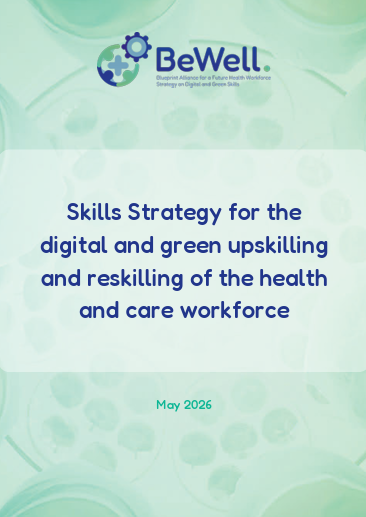
The BeWell Skills Strategy provides a European reference framework to support the digital and green transformation of the health and care workforce. Developed through a multi-year consultation process involving 765 stakeholders across Europe, the Strategy outlines how digital, green, and core competences can be embedded into workforce development, education systems, organisational practice, and policy frameworks. The Strategy supports policymakers, healthcare organisations, educators, professionals, and civil society actors in strengthening workforce resilience, sustainability, and preparedness for the future of healthcare.
Policy Briefs
BeWell project develops and publishes Policy Briefs aiming to liaise with policy and decision makers on the skills gaps, needs, and opportunities for the healthcare workforce.

Green skills for a sustainable future: Building a climate-smart health and care workforce in the European Union
This Policy Brief delves into core green skills and competencies for the health and care workforce, addressing the urgent need for the health and care sector to be able to adapt to and mitigate the effects of climate change.With rising environmental challenges, healthcare professionals should be equipped to implement sustainable practices, reduce carbon footprints, and support climate-resilient healthcare systems. This brief explores essential skills and competencies and available education and training initiatives, and suggests policy options to help foster a greener and more sustainable health care sector.
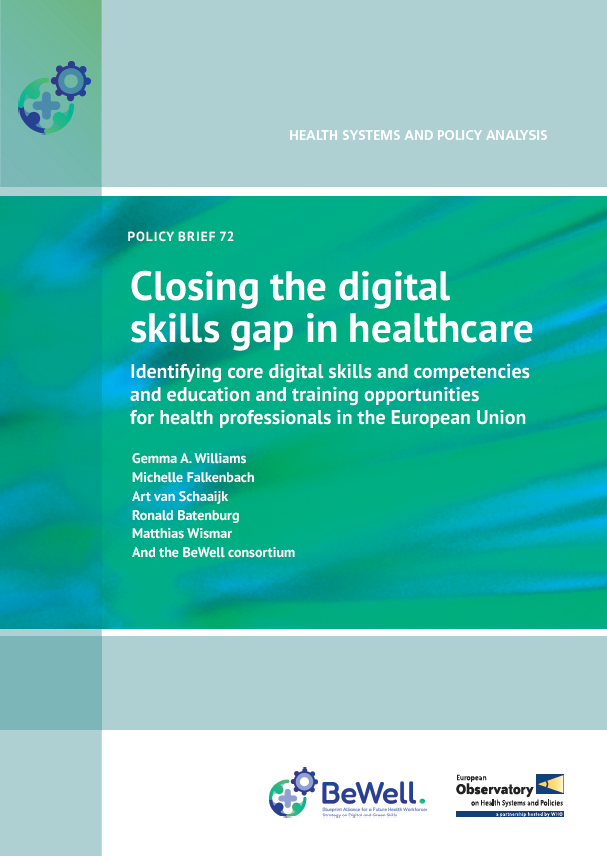
Closing the digital skills gap in health care: Identifying core digital skills and competencies and education and training opportunities for health professionals in the European Union
This Policy Brief examines core digital skills and competencies for the health and care workforce that can help equip health professionals with the tools they need to navigate an increasingly digital healthcare landscape. From telemedicine to AI-powered diagnostics, digital transformation is reshaping healthcare delivery. This policy brief highlights key strategies and explore available education and training initiatives in the EU that can enhance digital literacy, and ensure that health professionals can confidently leverage new technologies to improve patient care and working conditions. It also outlines some key new and emerging technical and support roles that will be needed in the health sector to aid the digital transition.

BeWell Competences Matrices
The BeWell Competence Matrices offer a simple and organised way to define and assess one’s key skills needed to succeed in today’s fast-changing, digital, and sustainable job market. BeWell Competence Matrices help people identify and improve important digital skills and green skills, as well as new job roles for the future. They make it easier to understand and recognize these skills across different countries, helping healthcare professionals be better prepared for future challenges and opportunities, have job plasticity or move to new places. This also makes it easier to see what skills someone already has, creating a more skilled and sustainable health workforce. These matrices outline the essential learning outcomes (competence, skills, and knowledge) that learners must acquire across various sectors, aligning with modern educational and professional demands.

BeWell Courses on Digital & Green Skills & Next Generation Digital and Green Skills
The BeWell project addresses the need to prepare the health and care workforce for green and digital solutions introduced in the European health and care systems with a series of dedicated online courses.
Build the green and digital skills shaping the future of health and care, and receive a BeWell Certificate on completion.
Digital Skills
Empower your digital journey with 12 versatile courses designed to enhance your skills.
Green Skills
Get ready for a sustainable future with our 4 focused Green Skills courses.
Next-Generation Green and Digital Skills
Step into the future of healthcare with 9 innovative courses combining cutting-edge digital tools and sustainable practices.

Eurohealth: BeWell edition
The BeWell Competence Matrices offer a simple and organised way to define and assess one’s key skills needed to succeed in today’s fast-changing, digital, and sustainable job market. BeWell Competence Matrices help people identify and improve important digital skills and green skills, as well as new job roles for the future. They make it easier to understand and recognize these skills across different countries, helping healthcare professionals be better prepared for future challenges and opportunities, have job plasticity or move to new places. This also makes it easier to see what skills someone already has, creating a more skilled and sustainable health workforce. These matrices outline the essential learning outcomes (competence, skills, and knowledge) that learners must acquire across various sectors, aligning with modern educational and professional demands.